Monday, May 30, 2011

Hanging Out With The Aga Khan


The Aga Khan, a descendent of Ali--the first Imam, and leader of millions of Ismali Muslims

My grandfather, a former associate editor of the Saturday Evening Post, had written profiles of the Duke of Edinburgh, of Kate Hepburn and of Princess Margaret when he moved to France for three months in the early 1950's to work with the Aga Khan on his memoirs.


Inside the Aga Khan's villa in Le Cannet on the French Riviera

Charles Murphy, who co-wrote The Windsor Story with Grandpa Joe, continues the story:


The Aga, who had been President of the League of Nations, fancied himself a world statesman; and his autobiography, as he visualized it, would commemorate his accomplishments as an adroit international negotiator and astute political prophet--this despite his confident reiteration of the late 1930's of the same unfortunate prediction which he had voiced in 1914:the great powers would not fight each other. The Aga's activities in diplomacy proving insufficient to fill out a book, Bryan ventured to suggest that he would command a far wider audience if he were to discourse on his vast acquaintance with fine horses and beautiful women (topics where his authority is beyond dispute), and on the divinity that periodically moved his adoring subjects to match his not inconsiderable weight ( 220 pounds on a 5ft 5 in frame) with its equivalent in jewels and precious metals.


Sir Sultan being weighed in front of a stadium full of onlookers in Mumbai in 1946. The packets making up his weight are full of diamonds, donations which he converted to cash in order to fund charitable endeavors across Asia and Africa.

The Aga said this would be undignified ,and the collaboration dissolved amicably. Bryan explained, "The publishers and I wanted a portrait; the Aga wanted a statue".


The Aga Khan driven by his wife Begum Om Habibeh Aga Khan


The Aga Khan's "statue", World Enough & Time - The Memoirs of Sir Sultan Mohammed Shah, Aga Khan III, was published in 1954 without Grandpa Joe's input. Both he and Charles Murphy ( who had written The Duke's autobiography A King's Story and The Duchess's memoir The Heart Has Its Reasons)would be enlisted by The Duke of Windsor for two books, including a frank account of his miserable childhood. They were never to be written. The Windsor Story, was published in 1979.


Charles Murphy and J Bryan III

Sunday, May 22, 2011

The Stepfather: John O'Hara


"Better than anyone else, he told the truth about his time. He was a professional. He wrote honestly and well."


That is the epitaph, enscribed on a tombstone in a Princeton cemetery, that John O'Hara wrote for himself.


The best selling author of dozens of novels and short story collections, including Appointment in Samarra, BUtterfield 8, Pal Joey and Ten North Frederick, O'Hara was as gifted a writer as any of his generation.


Ernest Hemingway, Sherman Billingsley and John O'Hara at Billingsley's Stork Club


Ernest Hemingway said "If you want to read a book by a man who knows exactly what he is writing about and has written it marvelously well, read Appointment in Samarra."


But O'Hara, who grew up not in the posh country clubs of his characters but in Pennsylvania coal mining country, always had a chip on his shoulder. He developed a reputation as a terrible tempered "Champion of the Imagined Slight".


When The New Yorker's Brendan Gill offered to buy O'Hara a drink shortly after giving O'Hara's novel A Rage To Live a bad review, O'Hara said "I wouldn't sit down with a son of a bitch like you for anything in the world." There's a story of O'Hara getting into an argument with a midget sitting next to him and was about to punch him when a second midget showed up and the two together knocked O'Hara off his feet and began beating on him until the bartender broke it up.
O'Hara and Oma


But there is another O'Hara: My father's step-father. In a July 1985 article for Esquire, Dad remembered O'Hara as an "intensely shy, warm gentle man, a devoted father to his daughter, Wylie, patient, hospitable and affectionate with his visiting stepchildren and our spouses and children despite the obvious disruption we caused in his routine, and --especially in the case of my own fledgling writing career--generous with his asked-for advice."


Dad, Unknown, Me, O'Hara


The O'Hara routine meant we didn't see a lot of him when visiting Oma in Princeton. O'Hara wrote at night, usually from midnight until dawn. I remember visiting his study one morning and burning my fingers on lamps that had been on all night. I'd play with the mechanical banks and toy cars he'd lay down on the floor for me and stare at his collection of antique horns. (It's stunning to think that the entire study--with the toys, horns and those very same lamps can be visited at Penn State University.)


O'Hara's study at Penn State


O'Hara had at least two great loves in his life. The first was Belle, who gave birth to O'Hara's only daughter, Wylie, and died nine years later in 1954. The second, O'Hara often said, was the first person he saw when he entered Princeton's Trinity Church for the funeral: Belle's friend, my father's mother, Katharine Barnes Bryan. Friends called her "Sister", a childhood nickname.


After Oma's death, my dad and aunt came across a large brown bag filled with love letters O'Hara had written to our grandmother. They reveal a side of O'Hara no biographer or critic ever knew existed:


You are a lovely, splendid, dear, sensitive, knowing girl, and you are my wife and my life and I will be good to you and try to be good for you...Oh, my darling, you don't know the surpassing peace that your letters have given me. I wonder if it is so bad to be so dependent on another person as I am on you, you the symbol and cause, and , possibly, the real source of our love.


Do you know what? Not to make you self-conscious, but I think I can see how you look when you read this. Smile for John, Sister; these words are a kiss.


Oma and O'Hara


Although Appointment in Samarra did make The Modern Library's list of the best 100 English language novels of the Twentieth Century, I think the place to start is with "Do You Like It Here?" a short story about a new boy at a prep school who's accused by his corridor master of having stolen a watch.
Then you'll begin to understand why Brendan Gill ( yes, the very same Brendan Gill) ranks O'Hara "among the greatest short-story writers in English, or in any other language" and credits him with helping "to invent what the world came to call the New Yorker short story."


Sunday, May 8, 2011

Happy Birthday/Mother's Day Mom!


1963 This is the first year I haven't sent Mom a birthday/mother's day card. Mother's Day always falls on or around her May 9th birthday.

1965
I would be calling today to tell her the whippet Gryffor is doing much better with the medication we're giving him. The kids are both playing in a baseball league. I'm heading off to France this week and my wife's decorating business seems poised for lift off.


1971 And I'd say how much I miss her and love her. And I promise to visit this Summer and bring her grandchildren. And yes, they eat too much junk food. Love you Mom.

Friday, May 6, 2011

John Randolph Bryan: The Confederate Aeronaut, 1862


As a child my grandfather was given a book called Brave Deeds of Confederate Soldiers. It fell open to the name "Bryan" so naturally he read on:


A certain Captain Bryan, a young aide-de-camp of General Magruder's, was borrowed by Gen. Joseph E. Johnston in the spring of '62 and sent up in in a balloon made up of hundreds of Sunday-go-to-meeting silk dresses. His mission: to map McClellan's dispositions around Yorktown. Bryan had never seen a balloon before. This one was blinding in its blaze of colors. It was controlled by a cable from a drum and windlass.


Well, the balloon bounced and whirled and rocked, and the Yankees shot at it with everything they had, but Bryan managed to do his job and get down again. He gave the maps to General Johnston and asked, in the stilted language of that time, "Will you not now, sir, reassign me to General Magruder?"


"Sir," Johnston said--and his smile was lined with sharp teeth--"you forget that you are my only experienced aeronaut. Pray hold yourself in readiness for another ascension at any moment!"

Next day he went up again. This time, as he was being wound down, a sky-gazing soldier got his sleeve caught between the cable and the drum and his arm was being drawn in and crushed when someone snatched up an ax and cut the cable. The balloon rocketed skyward until its hot air cooled. Then it fell like an anvil--fortunately, splashing down into the York River, and Bryan swam safely ashore.


My grandfather was impressed by the story and turned back to the beginning:
"John Randolph Bryan...born in Gloucester County...": Why, that sounded like his Great-uncle Ran! He read on:"Youthful appearance...cool and sturdy...brave as a lion..." The John Randolph Bryan he knew had a huge grey beard, and his knuckles were swollen and calloused from his trick of gnawing them when he brooded. Could they possibly be the same person?


Suddenly he knew that they had to be and right then a war that hitherto has been impossibly remote now drew so close that it seemed to have ended just the other day.


The drawings are by Salvatore Murdoca from the Burke Davis book Runaway Baloon: The Last Flight of Confederate Air Force One. Most of the words are from my grandfather, J Bryan III from his book The Sword Over The Mantel.

Friday, April 22, 2011

Happy 75th Birthday Dad!


Strange how such a giant man in my life could have been born so small.


Firollo Laguardia was the mayor of New York City when dad was born at Doctor's Hospital. The physician who delivered him also delivered my sister and me.


He was named after his mother's brother, Courty Barnes then stationed in the State Department's Far East Division.

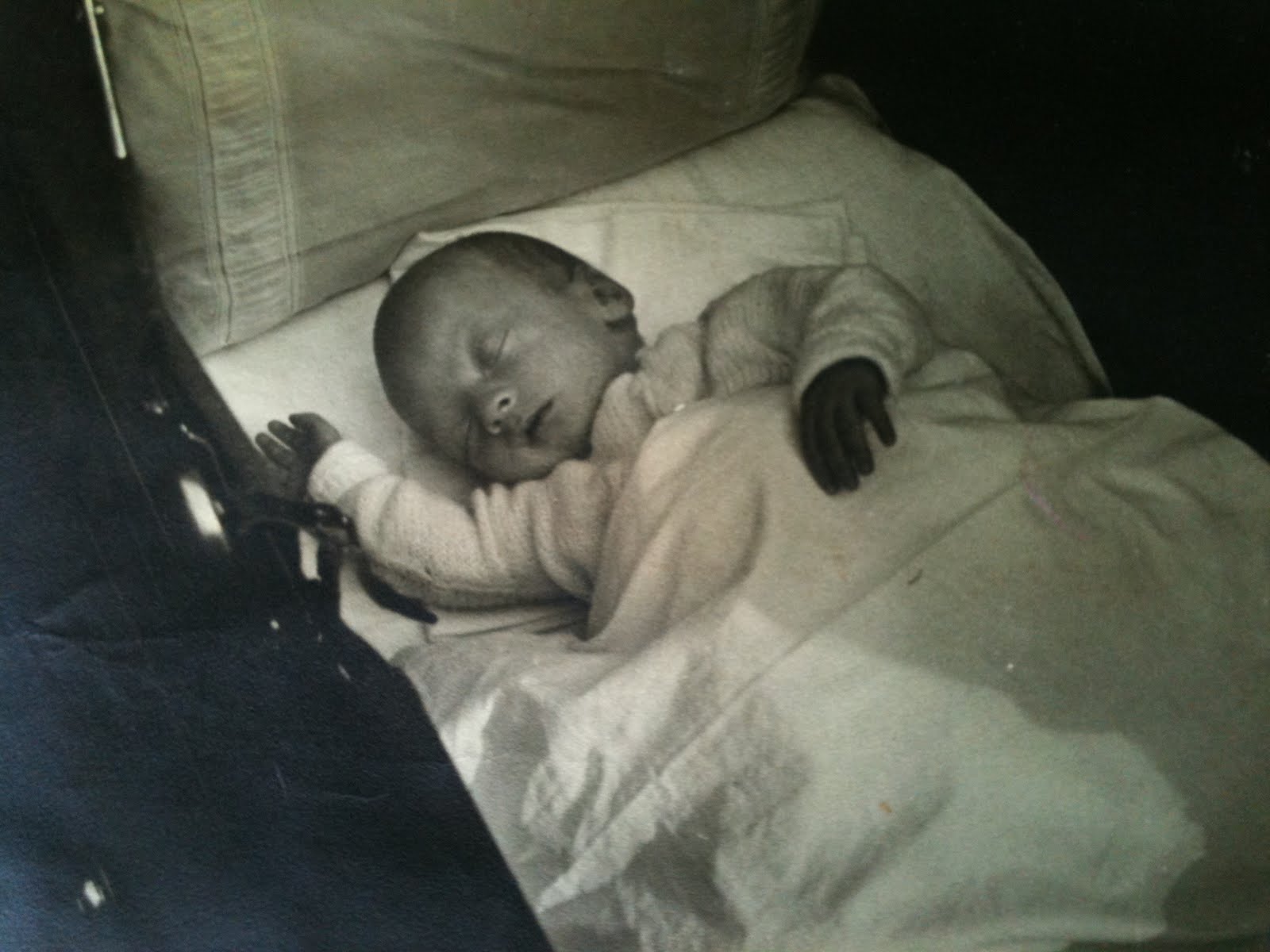
Dad was one of the geat nappers even at a young age.


The engraved pewter cup is a time honored tradition. I suppose they're even safe to drink from.
Photos courtesy of Lansing

Tuesday, April 12, 2011

The Inheritance That Barks


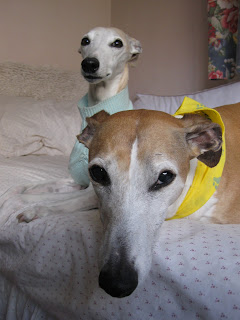
Whippets are strange looking dogs. They look like some kind of genetic experiment combining dogs and deer. They're dogalopes.

When we first met the two whippets Mom adopted from rescue shelters, my wife and I thought they were kind of creepy.Gryffor and Pippi took over the couches and beds. They napped all day. They were far too skinny. What's there to love except bones covered in thin hairs?

And yet Mom did love them. Maybe not more than all of her grandchildren. But ranked together, they would come somewhere in the middle of a personal poll.


Every time I visited Mom, we'd take these eerily quiet dogs out for walks. They had their own way of communicating with each other. They'd weave back and forth, tangling the leashes. I kept my eyes open for squirrels so I'd be ready for them to leap out of my clutches. They knocked down Mom a few times chasing squirrels. Another reason I wasn't much of a fan.


But Mom loved their sweet disposition. She was heartbroken when Pippi died, and she needed to make sure Gryffor would have a home if things didn't pan out for her. So, after checking with my sisters, I told Mom we'd take Gryffor. In Mom's final days, Gryffor seemed to sense what was going on. I thought this photo spoke for all of us.


After Mom passed away I drove home with Gryffor. Two boys silently riding home with heavy hearts. When we got home, I walked Gryffor straight through our house to the backyard. He nearly chased down one of our cats. There would be an adjustment period.

And during that period I learned whippets are really quite wonderful dogs. During the day, they want to be near the action--near the family--but they don't need to be in the middle of the action. At night they are hot water bottles... leaping into any bed they can find to snuggle up against anybody. Gryffor seemed to be happy to be part of this young family.

We'd take him for walks. Just picking up the leash makes him do a happy dance to the door. We'd watch him get his "whippet" out by dashing at full speed from one end of the backyard to the other. And we'd catch him sitting under the kitchen table waiting for scraps to fall. Every time I'd get home from work, Gryffor would be there, tail wagging at a furious pace.

Now, after a wet and cold winter, Gryffor isn't doing so well. He's twelve years old after all. That's somewhere near life expectancy for a whippet. His back legs tremble all the time. It's such a common sight among old whippets, dog people refer to it as "the back end going". We've added medicine to his diet and that seems to help. We've laid down rugs so his back legs aren't skating along the wood floors. We still take him for walks but they are shorter and more patient.


There's yet another sad day in the forecast. A day when, once again, we will have to say goodbye


For more on Mom: http://saintbryantv.blogspot.com/2011/01/phoebe-miller-bryan-1938-2010.html

Tuesday, April 5, 2011

The Family Firm 1958


Dad was a Cadet 1st Lieutenant enrolled in the R.O.T.C. program at Yale University when he filled out his application to work at the CIA. He was hoping to edit or interpret written data "in a field pertaining to Army matters". His previous job experience included the 1955 summer he spent as a roustabout with Barnum and Bailey Circus and two summers as a handyman at the Block S dude ranch in Elk, Wyoming. Still Dad had reason to hope he'd get the job because both his uncle and father had worked at The Agency.

His uncle was Tracy Barnes, a former war hero who four years earlier managed the covert overthrow of the democratically elected president of Guatamala. In 1961 he was still the "golden boy" of the CIA when he helped plan and oversee the failed Bay of Pigs invasion, an attempt to oust Fidel Castro.

My grandfather ran the Psychological Warfare Workshop at the agency. He hired a bright group, but as Evan Thomas writes in his book The Very Best Men "he seems to have recruited from the Princeton Tiger, his college humor magazine." He brought on board the writer Finis Farr and the legendary practical joker Hugh Troy. One propaganda stunt they come up with was to drop extra large condoms --labeled "medium" in English--on the Soviet Union.

The psywar staff did carry out one memorable propaganda stunt, funding the animated version of George Orwell's Animal Farm (1954). They managed to change the ending of the story to give it a distinctly anti-pig ( and therefore anti Communist) ending. My grandfather helped the CIA buy the rights to Animal Farm by introducing Orwell's widow to Clark Gable.


But if Dad thought he'd have an easy time getting accepted into the family firm, he was sadly mistaken. In P.S. Wilkinson his alter ego takes a lie detector test and "fails" questions about his sexuality. It ends with a physical by a lisping physician.

"You look very young. How old are you?"

P.S. felt the hair rising on the back of his neck. There was something horrible about the man's voice. It's tone. "Twenty-four," P.S. said.

You don't look that old."

A shiver ran through him, and P.S. started to sit down.

No, no!" the doctor protested. "Don't sit down yet. Let me look at you."

P.S. remained standing where he was. His skin felt cold and damp.

"My, you're tall?" the doctor said. "Are you long all over?"